Showing posts with label research. Show all posts

Tuesday, June 5, 2012

Farm women’s recreations


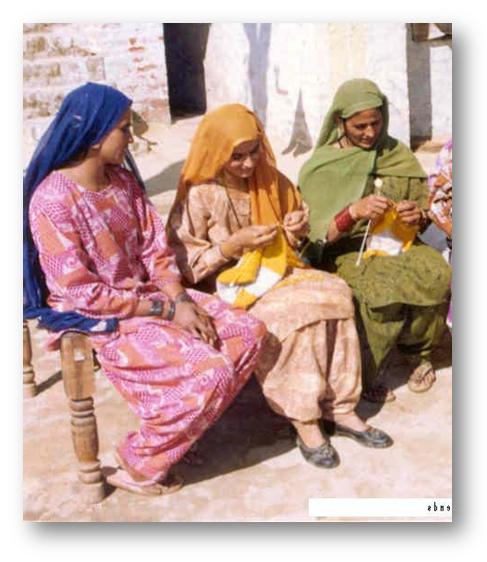
Farm women, from the neighborhood meet together while collecting fuel (leaves, barks, shrubs, twigs), fodder, and wild-food like cholaai, kondra, teent, peal (wild fruit), from the nearby waste lands and, fields and during bringing water.  


During such discussions, women share their ideas with one another which not only create opportunities for self-expression (they also discuss misbehaviour conducted to them by older member of their families), but also symbolize some degree of group solidarity. 
tribuneindia;carrying water

tribuneindia:bringing fodder

On these occasions, women meet together and discuss personal, family, and village affairs as they go about the work of fuel collection or fetching water. 
  Women, especially housewives, almost universally cherish the experience of visiting houses of close kin. For a young, newly married housewife, the greatest recreation can be a piihar-a short, periodic visit to her parents from her husband's home. During such visits, women generally take a break from the burden of daily work and pass the time by meeting kin and friends.
Drabble 
Happy reading!!!!!!!

Monday, June 4, 2012

Kantaha,research on the topic

Kantha 
Etymology
The word kantha has no discernable etymological root. The exact time of origin of the word kantha is not accurately known but it probably had a precursor in kheta (khet in Hindi and Bengali means "field").According to Niaz Zaman, the word kantha originated from the Sanskrit word kontha, which means rags, as kantha is made of rags.
Kantha Tradition
Like any other folk art, kantha making is influenenced by factors such as materials available, daily needs, climate, geography, and economic factors.[11] Probably the earliest form of kantha was the patchwork kantha, and the kanthas of the decorative applique type evolved from this.
Kantha in Literature
The earliest mention of Bengal Kantha is found in the book "Sri Sri Chaitanya Charitamrita" by Krishnadas Kaviraj, which was written some five hundred years ago.
Kantha Making
Traditionally old sarees, lungis and dhotis were used to make kanthas. Kantha making was not a full time job. Women in almost every household were expert in the art. Rural women worked at leisure time or during the lazy days of the rainy season, so taking months or even years to finish a kantha was normal. At least 5-7 sarees were needed to make a standard size kantha. Today the old materials are replaced by new cotton cloths. Traditionally the thread was collected from the old sarees. That is rarely done today.
When making a kantha, first the sarees are joined together to attain the required size, and then layers are spread out on the ground. The cloths are then smoothed, leaving no folds or creases in between. During the process, the cloth is kept flat on the ground with weights on the edges. Then the four edges are stitched and two or three rows of large running stitches are done to keep the kantha together. At this stage, the kantha can be folded and stitched at leisure time.
Originally, designs and motifs were not drawn on the cloth. The design was first outlined with needle and thread, followed by focal points, and then the filling motifs were done. In a kantha with a predominant central motif the centre was done first, followed by corner designs and the other details. In some types of kanthas (carpet, lik and sujni, etc.) wooden blocks were used to print the outline. The blocks are replaced today by patterns drawn in tracing papers.http://en.wikipedia.org/wiki/Nakshi_Kantha

photo via(Wikipedia)
some links here.......................
Handicrafts,India,SouthAsia,SouthEast Asia,Bangladesh,Bhutan,Maldives,Nepal,Pakistan,Sri Lanka
Aresearsh paper on sociological context of Bangal Kantha

Have a read!!!!!!!

Saturday, December 17, 2011

Research is.......

If we knew what it was we were doing, it would not be called research, would it?
Albert Einstein

Research is formalized curiosity. It is poking and prying with a purpose.

Research is creating new knowledge.
Neil Armstrong

In much of society, research means to investigate something you do not know or understand.
Neil Armstrong

How to Add Flag Counter Widget to Blog

Monday, May 17, 2010

My paper published in IJMCH

My research based paper was published in Indian J Matern Child Health
here is the abstract....

Abstract

PIP: 48% of India's 844 million population in 1991 were women and 62% were women and children. The health status of this population is a concern of the government in striving for Health for All by the year 2000. In this study, 60 women from Kurri and Bherian villages within 10-20 km of Hisar city of Haryana State, India and 82 preschoolers were randomly selected for health assessment in April-May 1990. Health status was assessed with anthropometric measures standardized by Jelliffe. The results for the women were grouped into good (80=100%) of standard values), average (60-79% of standard values), and poor (below 60% of standard values). The majority of women (56.66%) were aged 25-50 years and had an average health status, 43.44% had a good health status, and none was found in poor health status. Scores for height, head circumference and mid arm circumference were scored as 1 unit for weight, and totaled with parameters for weight for age, height for age, head circumference for age. Total scores were then grouped as good for 10-12 points, average for 7-9 points, and poor for 4-6 points; scores were determined as 1 for below 60% of the standard values, 2 for 60-79% of standard values, and 3 for 80-100% of standard values. The health status of children was found to show 53.66% of preschoolers with average health status, 35.36% with good health status, and 10.97% with poor status. 25.61% of the girls had an average health status and 28.05% of the boys had an average health status. Simple correlation analysis showed that the good health status of the mother was an important indicator of good health status of preschool children (r = .705, p .01). The health status of girls vs. boys was not found to be markedly different.

link here...

Health status of women and children (pre-schoolers) in rural areas of Haryana.

Bimla RA, Singal S.

Indian J Matern Child Health. 1993;4(2):52-4.PMID: 12318487 [PubMed - indexed for MEDLINE]